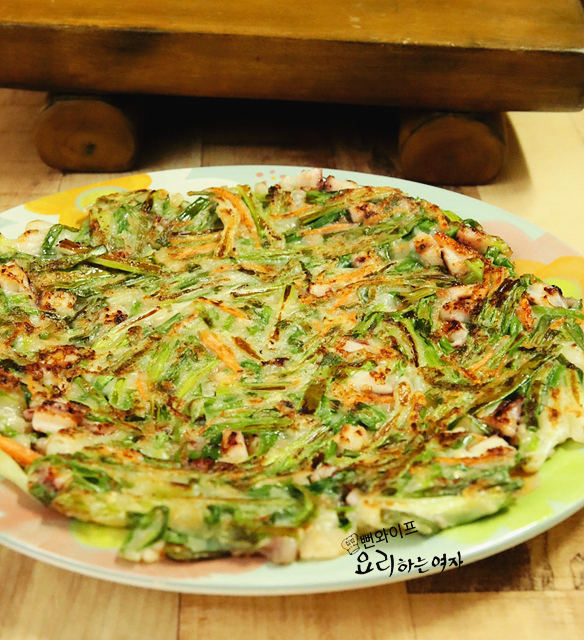
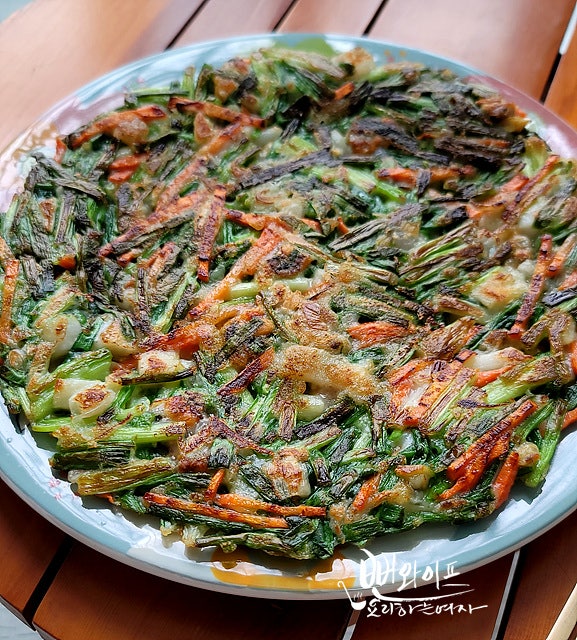
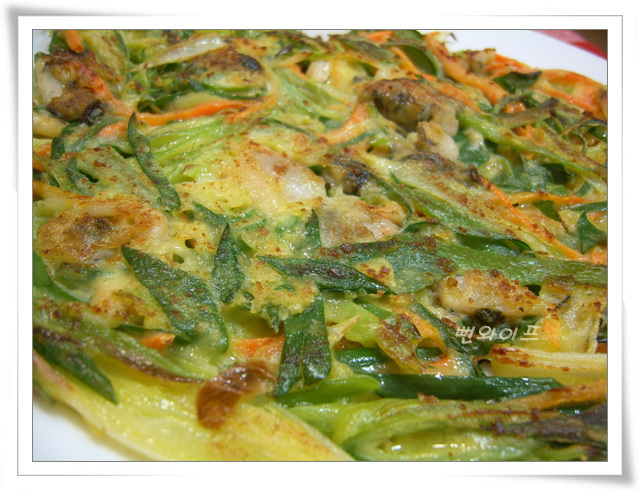
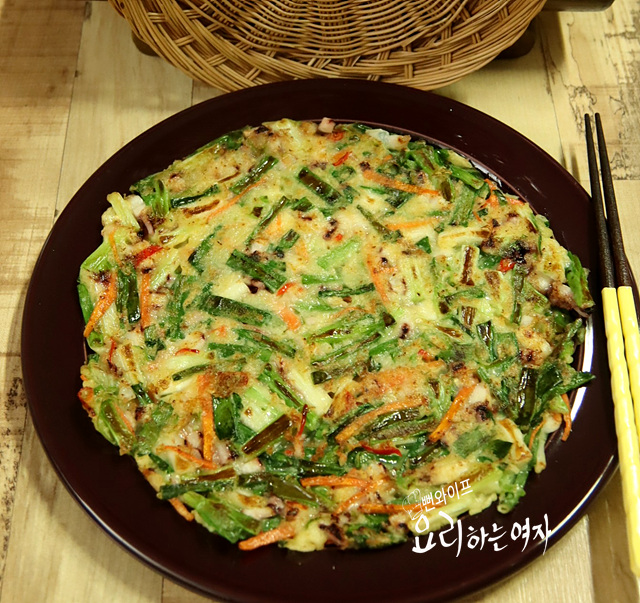
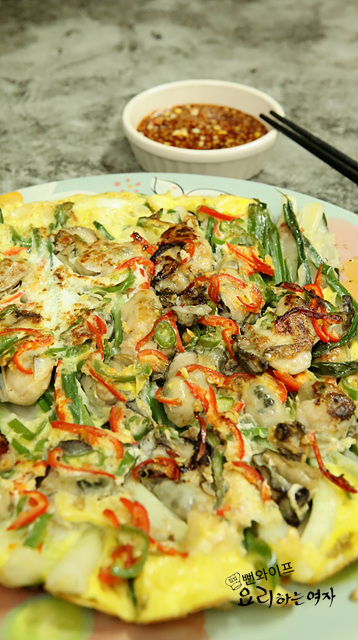
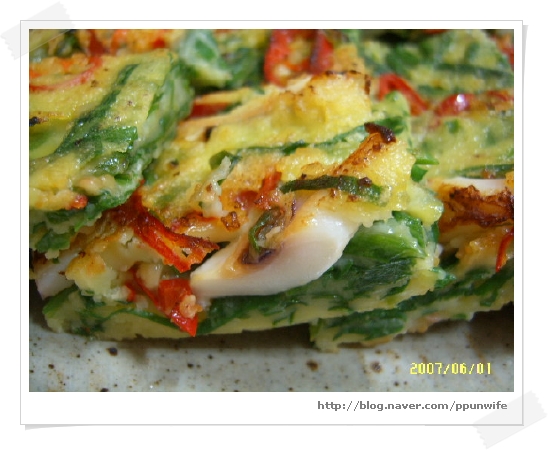
Dongnae Pajeon (Scallion Pancake with Seafood)
A savory, thick pancake topped with scallions and seafood, finished with beaten egg and pan-fried until golden.
Translated from Korean by AI and not yet checked by a native speaker. Amounts and numbers are taken directly from the original recipe. Read the Korean original →
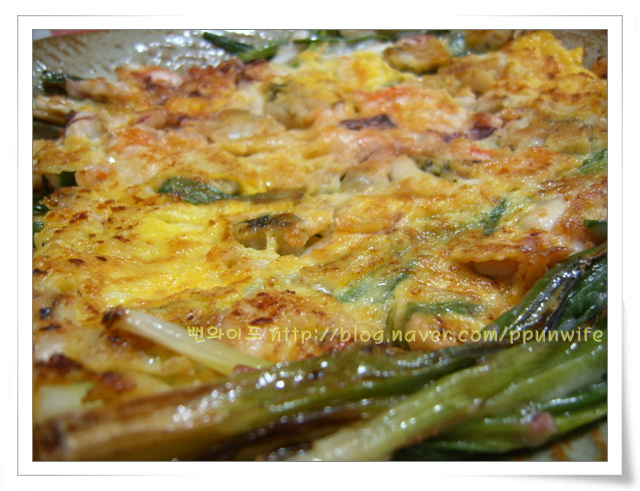
Korean pancake mix and glutinous rice flour are mixed with anchovy broth, then pan-fried with a generous topping of scallions and seafood. Covered with a lid to cook through to the center and finished with beaten egg until golden brown, it makes a wonderful treat when paired with pickled chili peppers or chogochujang.
- Servings
- about 3–4 servingsOriginal: 3 plates
- Difficulty
- Medium
- Spiciness
- Not spicy
Ingredients
Ingredients
- Scallions (jjokpa)300 g
- Clam meat100 g
- Squid1 whole
- Shrimp10 (medium)
- Egg3
- Salt1 tsp
Batter
- Glutinous rice flour1/3 cup
- Korean pancake mix (buchim-garu) (or flour)1 cup
- Anchovy broth (or water)1.3 cups
- Prepare three generous handfuls of silpa (thin scallions) or scallions (jjokpa). You can also add water dropwort (minari), or oysters when they are in season, or season some beef and pan-fry it along with the seafood.
- Roughly chop the seafood, and beat 3 eggs.
Steps
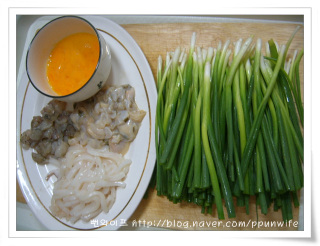
1. Prepare three generous handfuls of silpa (thin scallions) or scallions (jjokpa). One handful makes one pancake.
You can also add water dropwort (minari), or oysters when they are in season.
You can also season beef and pan-fry it along with the seafood.
Roughly chop the seafood. Beat 3 eggs.
Use 1 egg per pancake.
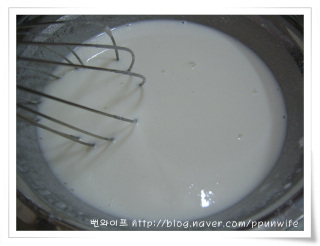
2. Originally, Dongnae pajeon batter is made by mixing glutinous rice flour and regular rice flour, then dissolving gochujang (Korean red chili paste) or fine chili flakes into it.
I used what I had at home, combining Korean pancake mix (buchim-garu) and store-bought glutinous rice flour in a 3:1 ratio.
If you use too much glutinous rice flour, it turns chewy but gets soggy and loses its crispness.
Instead of gochujang, I seasoned with salt and poured in anchovy broth to make the batter.
When mixing the batter, do not pour in all the anchovy broth (or water) at once; pour it in little by little to adjust the consistency.
If it is too thick, the pancake will turn out dense, so aim for the consistency of plain yogurt or slightly thinner.
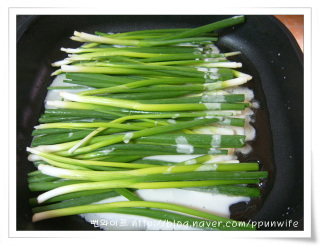
3. Heat oil in a preheated pan, spread a thin layer of batter, and lay the scallions on top, alternating their directions.
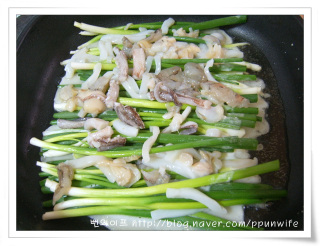
4. Evenly scatter the seafood over the scallions.
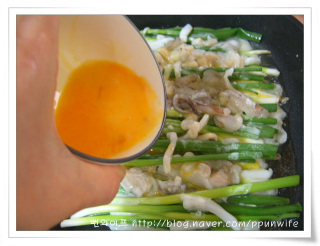
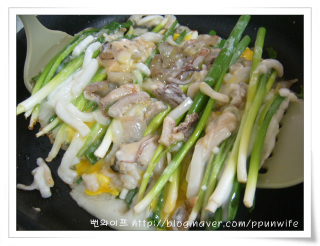
5. Drizzle a little batter over the seafood just enough to hold the scallions and seafood together,
spoon some beaten egg over it, and once the bottom is cooked...
6. Hold spatulas in both hands and carefully flip it over.
If you flip it before it has cooked enough, it will lose its shape, so give it plenty of time before flipping.
(Another method is to flip it once, then pour the egg over it to cook.)
Because there is a lot of seafood, cover the skillet with a lid so the inside cooks through,
adjust the heat between medium and low, and cook thoroughly.
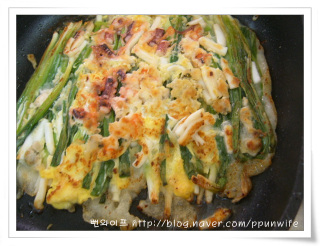
Flip it over again, and once the batter and seafood are browned and cooked through, it is done.
 Ppunwife's tips
- If you use too much glutinous rice flour, the pancake turns chewy but goes limp and loses its crispness.
- When making the batter, do not pour in all the anchovy broth (or water) at once; add it gradually to adjust the thickness. If it is too thick, the pancake will be heavy, so aim for the consistency of plain yogurt or slightly thinner.
- Flipping too early can cause the pancake to break apart, so take your time before flipping.
- Because there is a generous amount of seafood, cover the frying pan with a lid so it cooks through to the center, and let it cook thoroughly over medium-low heat.
- Since these seafood scallion pancakes do not contain spicy peppers, they are delicious served with pickled Cheongyang chili peppers or dipped in chogochujang (sweet and sour chili paste).
FAQ
What consistency should the batter be?
A consistency like plain yogurt or slightly thinner is ideal. If it is too thick, the pancake will turn out dense, so adjust it by pouring in the broth little by little.
What happens if I add a lot of glutinous rice flour?
The texture becomes chewy, but the pancake will sag and lose its crispness. Therefore, mixing it with Korean pancake mix in a 3 to 1 ratio is recommended.
How can I ensure the inside of the thick pancake cooks through?
Cover the frying pan with a lid and cook gently over medium-low heat so that the seafood cooks thoroughly.