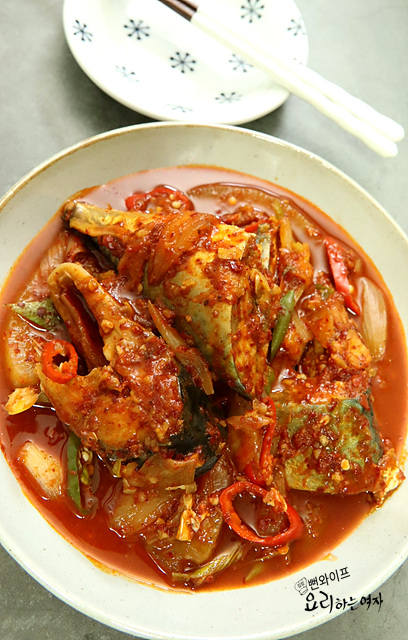
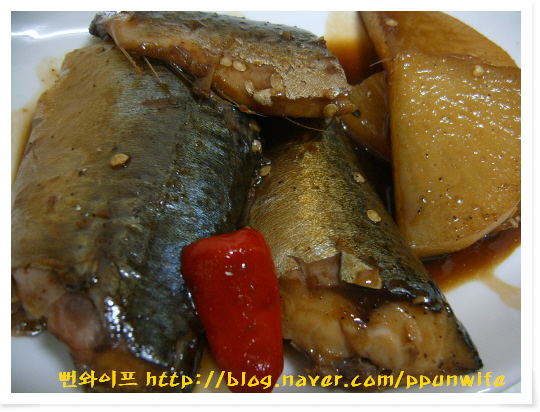
Spicy Godeungeo Jorim (Braised Mackerel)
A spicy braised mackerel side dish pretreated with rice water and having its thin skin membrane removed to eliminate fishy odors.
Translated from Korean by AI and not yet checked by a native speaker. Amounts and numbers are taken directly from the original recipe. Read the Korean original →
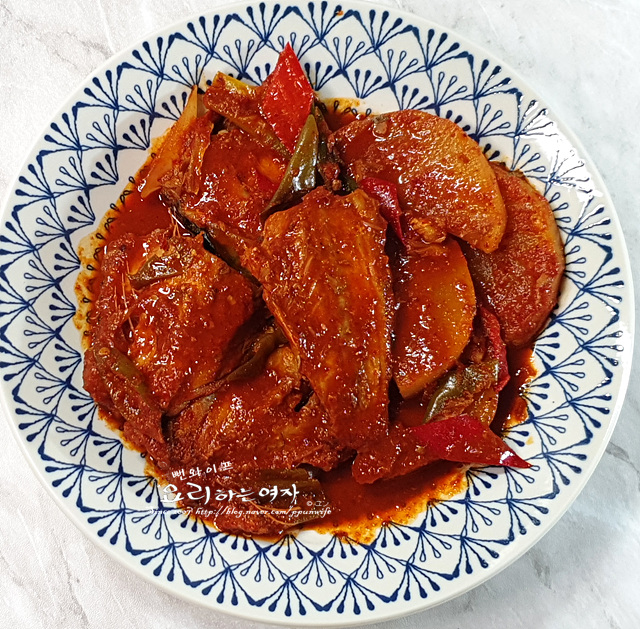
The thin skin membrane of the salted mackerel is peeled off, and the fish is soaked in water from washing rice to cleanly remove excess salt and fishiness. Korean radish is cooked first with seasoning, then topped with spicy sauce and simmered down. Braising with the lid open until the fish is fully cooked is the key to a clean, refreshing flavor.
- Servings
- 3–4 servings
- Difficulty
- Medium
- Spiciness
- Spicy
Ingredients
Ingredients
- Salted mackerel (gan-godeungeo)3 whole (medium)
- Korean radish (mu)1/3, 400 g
- Onion1/2
- Large green onion (daepa)1 stalk
- Cheongyang chili pepper (hot green chili)3
- Red chili pepper1
- Water from washing rice4 cups
Seasoning
- Regular soy sauce (jin-ganjang) (or brewed soy sauce (yangjo-ganjang))5 tbsp
- Gochugaru (Korean chili flakes)4 tbsp
- Gochujang (Korean red chili paste)1 tbsp
- Sugar1 1/2 tbsp
- Minced garlic2 tbsp
- Mirin (cooking rice wine)3 tbsp
- Minced ginger1/2 tbsp
- Ground black pepper1/2 tsp
- To remove the fishy smell from the braised mackerel, soak it in water from washing rice for at least 30 minutes.
- The 1 red chili pepper can be omitted.
Steps
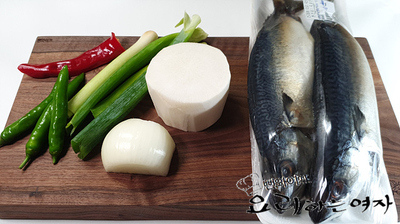
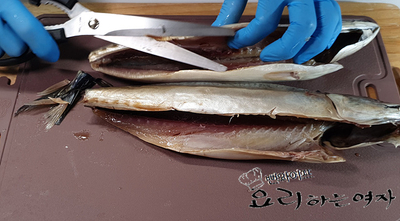
I used salted mackerel; it looks like two fish, but it is two pairs (4 fish).
Today I will braise only 3, and I grilled the remaining one to eat.
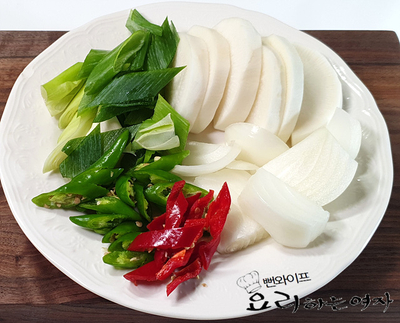
Prepare 1/3 of an average-sized Korean radish, half of a large onion, and one large green onion.
Also prepare 3 Cheongyang chili peppers, which help remove fishiness, and 1 red chili pepper (optional).
Use scissors to snip off all the fins attached to the mackerel.
Cut off the heads as well...
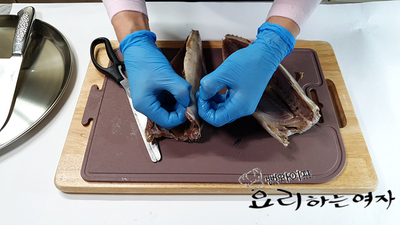
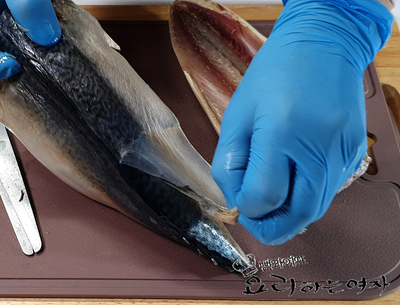
This is the first method for removing fishiness from braised mackerel.
Just like peeling squid skin, hold some fine salt, make a slight shallow incision at the end or in the middle of the mackerel, and gently peel it away; amazingly, the membrane peels right off.
I tried this tip after seeing it on the TV show Manmulsang, and they say it helps remove the fishy odor.
Cut the mackerel in half.
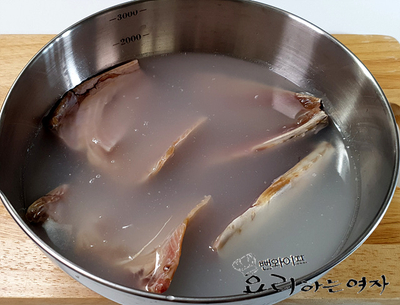
The second method for removing fishiness from braised mackerel is common knowledge if you have ever made this dish before:
soak it in water from washing rice for at least 30 minutes.
Doing this draws out excess salt from the salted mackerel and gets rid of a lot of the fishiness.
Use the water from the first and second rinses of washing rice to soak the mackerel, and use the water from the final rinse as the broth for braising.
Rinse the soaked mackerel under running water.
Cut the Korean radish thickly to about 2 cm, and slice the remaining vegetables into large diagonal pieces.
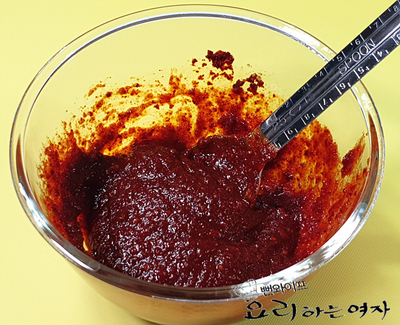
Combine all seasoning ingredients and mix them beforehand.
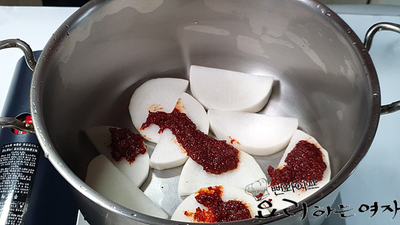
Place the Korean radish at the bottom of the braising pot, and spoon half of the seasoning over the radish...
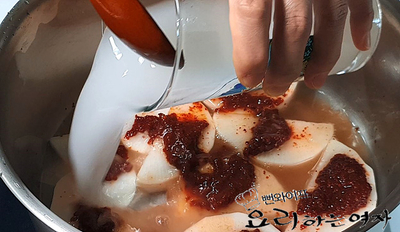
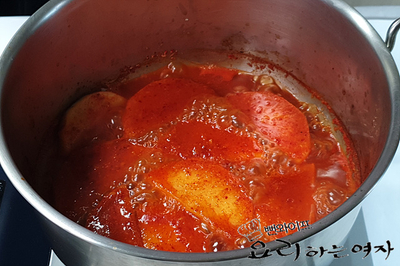
The third method for eliminating mackerel fishiness is using water from washing rice.
I find that rice water, which is cleaner tasting than anchovy broth and contains starch, is more effective for braised mackerel.
From the 4 cups of water from washing rice, pour in enough to submerge the radish.
This is the water from the final rice rinse.
Boil until the radish is about half-cooked...
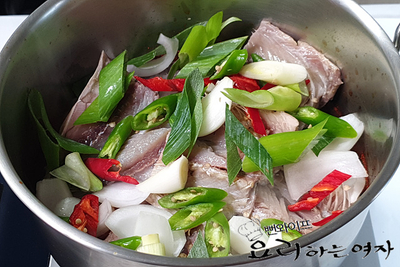
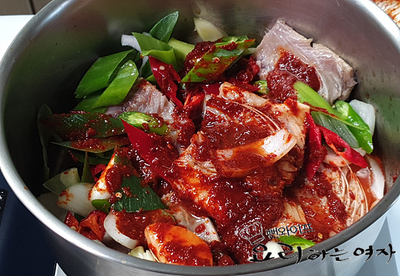
Place the mackerel on top, then evenly distribute the vegetables and the remaining seasoning over it...
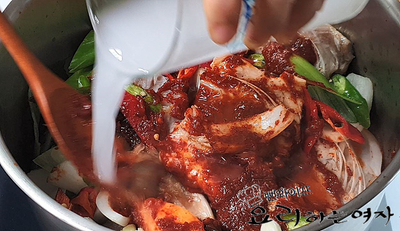
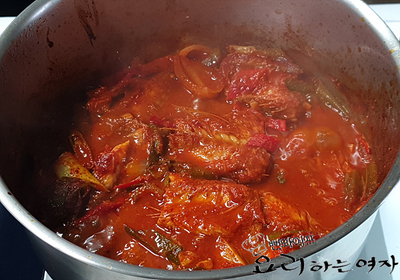
Pour in the rest of the water from washing rice and bring it to a boil.
Once it starts boiling, reduce the heat to low, ladle the broth over the fish, and braise until the liquid is reduced.
Do not cover with the lid until the mackerel is cooked.
Covering while undercooked can trap the mackerel's fishy odor, so cover to finish braising only after the mackerel is fully cooked and smells savory.
 Ppunwife's tips
- Just like peeling squid skin, hold some fine salt, make a slight shallow incision at the end or in the middle of the mackerel, and gently peel it away; amazingly, the membrane peels right off. I tried this tip after seeing it on the TV show Manmulsang, and they say it helps remove fishiness.
- Use the water from the first and second rinses when washing rice to soak the mackerel, and use the water from the final rinse instead of broth when braising.
- Do not cover with the lid until the mackerel is cooked. While it is still undercooked, lingering fishy smells can rise up, so cover to finish braising only after the mackerel is fully cooked and gives off a savory aroma.
FAQ
How do you peel the thin membrane from the mackerel skin?
Just like peeling squid skin, coat your fingers with fine salt, make a small cut at the end of the body or in the middle, then grip and pull to peel it off easily.
What is the benefit of using rice water as the braising broth?
It has a cleaner taste than anchovy broth, and its starch content helps remove unwanted fishiness from the mackerel while helping the seasoning blend together smoothly.
Why do you leave the lid off at the beginning of braising?
If you cover the pot while the fish is undercooked, the fishy odor cannot escape and will seep into the broth; you should braise with the lid open until the fish is fully cooked and smells savory.
Can I use fresh raw mackerel instead of salted mackerel? AI-generated
Generally you can cook with fresh mackerel, but since it is not salted, it is best to slightly increase the amount of soy sauce to balance the seasoning.