Deep, Refreshing Baechu Kimchi (Napa Cabbage Kimchi)
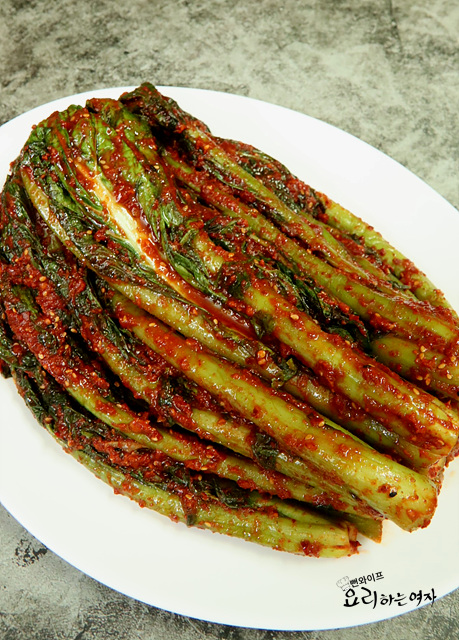
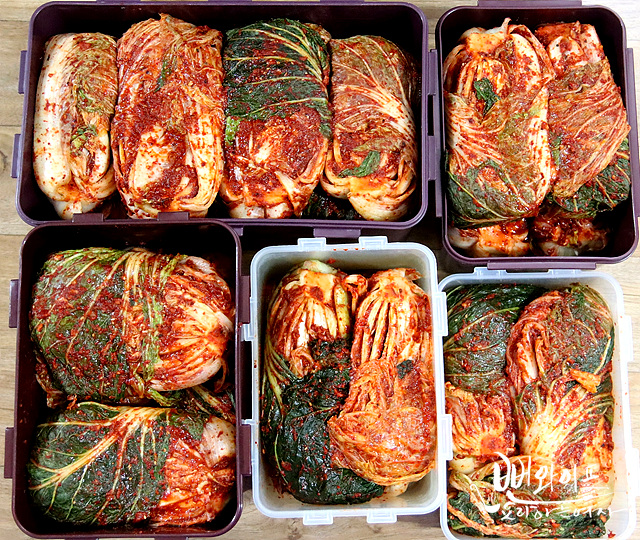
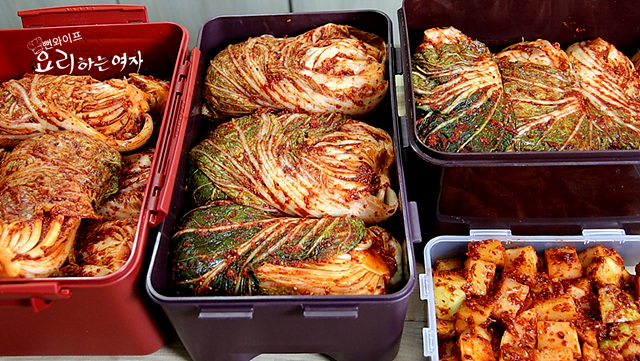
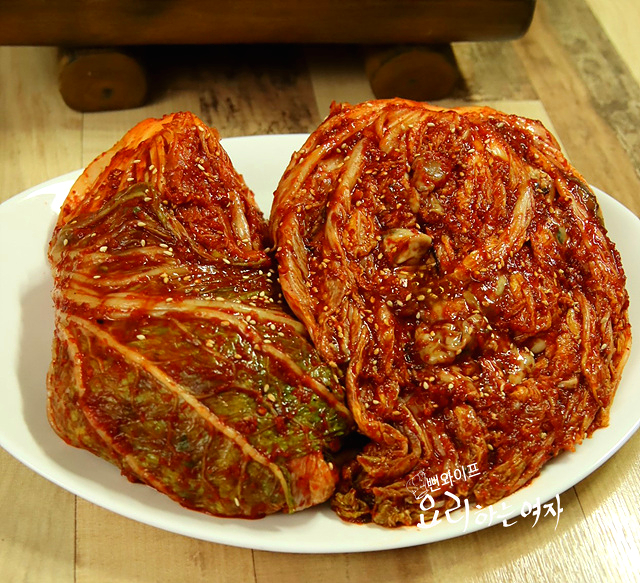
A 10-cabbage batch of napa cabbage kimchi featuring a rich dried pollock broth glutinous rice paste and sea staghorn seaweed for a crisp, deep flavor.
Translated from Korean by AI and not yet checked by a native speaker. Amounts and numbers are taken directly from the original recipe. Read the Korean original →
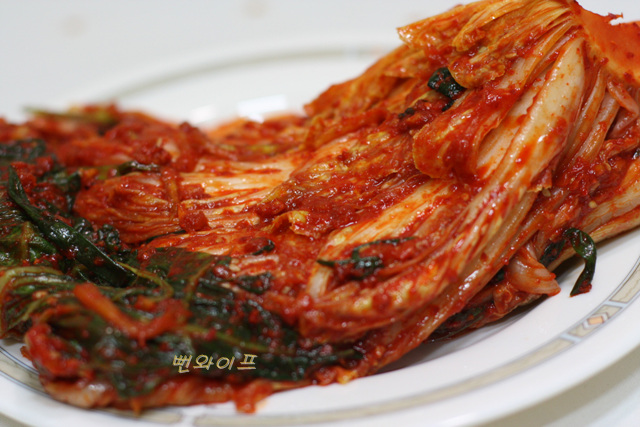
Glutinous rice paste simmered with a rich broth of dried pollock heads and dried kelp gives this kimchi a deep umami flavor without any artificial seasonings. Sized for 10 heads of napa cabbage, it combines shredded Korean radish, sea staghorn seaweed, mustard greens, and other aromatics for a vibrant, spicy filling. If you plan to add fresh oysters, fold them only into the portion meant for quick consumption rather than long-term storage.
- Servings
- about 10–12 servingsOriginal: Yields 10 heads
- Difficulty
- Hard
- Spiciness
- Spicy
Ingredients
Ingredients
- Napa cabbage10 heads, 2.5 kg (25 kg, approx.)
- Korean radish (mu)3, 2 kg (each)
- Scallions (jjokpa)500 g
- Mustard greens (gat)500 g
- Water dropwort (minari)300 g
- Sea staghorn seaweed (cheonggak)200 g
Seasoning
- Gochugaru (Korean chili flakes)15 cups
- Anchovy fish sauce (or sand lance fish sauce)2 cups
- Salted fermented shrimp (saeujeot)2 cups
- Minced garlic4 cups
- Minced ginger4 tbsp
- Sugar (or green plum syrup (maesil-cheong))4 tbsp
Glutinous rice paste
- Anchovy broth (dried pollock broth)5 cups
- Glutinous rice flour3/4 cup
- Vegetable weights are measured after trimming and preparing.
- The napa cabbage should feel firm to the touch, and the stems should not be overly thick. Cabbages weighing 2 to 2.5 kg are generally ideal and taste the best.
- 6 hours is an appropriate salting time for the cabbages, and it is best to drain them for at least 6 hours after rinsing.
- Instead of cooking a glutinous rice paste, you can also make kimchi using equal amounts of pear juice and Korean radish juice. For kimchi you plan to store and eat for up to 1 year, soaked raw glutinous rice cooked like porridge can be used instead of glutinous rice flour.
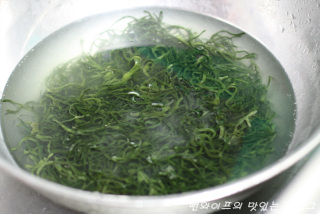
- Soak dried sea staghorn seaweed in water for about 30 minutes to soften, then rub it clean between your hands while washing.
- The recipe calls for 15 cups of gochugaru, but if you prefer a less heavily spiced kimchi, you may reduce it to 10 cups.
Steps
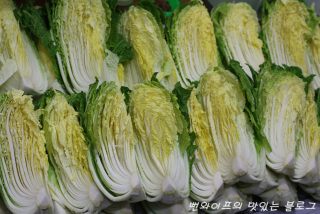
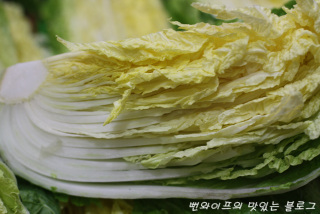
1. The napa cabbage should feel firm to the touch, and the stems should not be overly thick.
Cabbages weighing 2~2.5 kg are generally ideal and taste delicious.
Checking the weight of your cabbages before making kimchi ensures accurate seasoning measurements.
If cabbage weights differ, the amount of seasoning and salting salt must be adjusted accordingly.
That way, you can minimize any chance of failure.
Please keep this point firmly in mind.
Cut about 10 cm into the root end of the cabbage with a knife, then gently pull it apart with both hands so the leaves separate cleanly without crumbling.
If you slice all the way through with a knife, it will create a lot of scraps.
Cut once more in the same manner to cut into 4 parts.
Cleanly trim away the root core at the base with a knife.
2. The cabbage color is gorgeous. It is nutty and very tasty.
I ate quite a bit of the inner cabbage leaves while cutting.
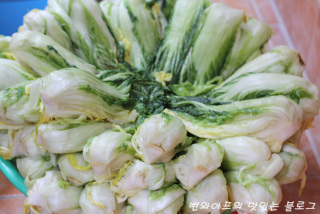
3. 6 hours is an appropriate salting time, but you can extend the time depending on how well the stems have softened.
Rinse the salted cabbage 2 to 3 times in running water and drain; it is best to let it drain for at least 6 hours.
I salted mine at night, drained it overnight, and made the kimchi the following morning.
See here for how to salt napa cabbage: http://blog.naver.com/ppunwife/140044943725
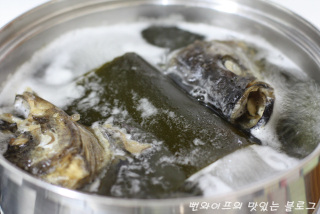
4. Simmering glutinous rice paste with a rich broth lets you create deep flavor in kimchi without adding any artificial seasonings.
I simmered 10 cups of water with 3 dried pollock heads (or 1 dried pollock) and 2 sheets of 10 cm square dried kelp for a long time until reduced to 5 cups to create a rich broth.
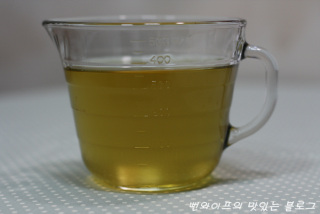
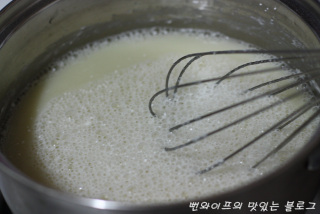
5. Let the simmered broth cool completely. This broth will be used to make the glutinous rice paste.
6. Add 3/4 cup glutinous rice flour to 5 cups of broth and cook over heat, stirring constantly to prevent lumps from forming.
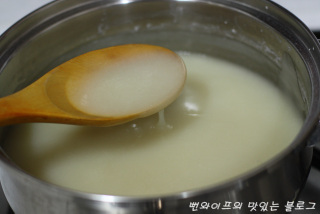
7. Once it reaches this thick consistency, let it cool completely.
For kimchi you plan to store and eat over the course of 1 year, soaked raw glutinous rice cooked like porridge can also be used instead of glutinous rice flour.
Glutinous rice paste helps ferment the kimchi; as an alternative to making paste, you can also make kimchi using equal amounts of pear juice and Korean radish juice.
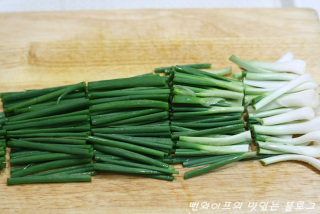
8. Cut scallions into 3 to 4 cm lengths...
10
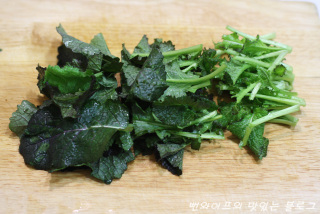
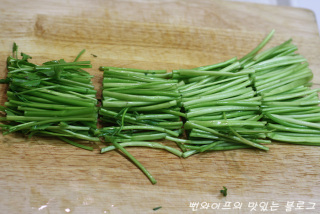
9. Water dropwort and...
10. Cut the mustard greens into 3 to 4 cm lengths, the same as the scallions.
Red mustard greens are typically used for baechu kimchi, while green mustard greens are mainly used for water kimchi.
11
12
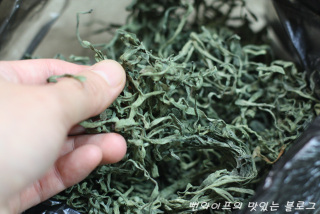
11. This is sea staghorn seaweed (cheonggak). It is a seaweed that adds a crisp, refreshing flavor to kimchi.
In the Busan and Gyeongnam regions, cheonggak is often included in the kimchi stuffing.
12. Soak dried sea staghorn seaweed in water. After about 30 minutes, it will soften; rub and wash it until the water runs clear.
13
14
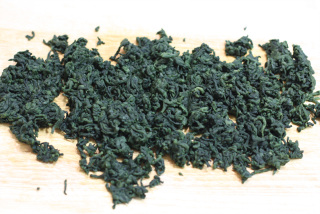
13. Squeeze out the water thoroughly and chop finely.
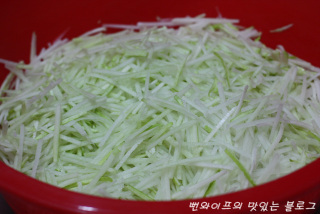
14. Julienne the Korean radish.
15
16
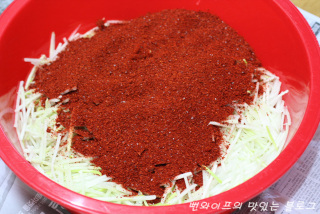
15. Add gochugaru to the julienned radish...
Our family prefers to use plenty of gochugaru for a deep red seasoning.
I used 15 cups, but if you do not want as much gochugaru, you can use 10 cups.
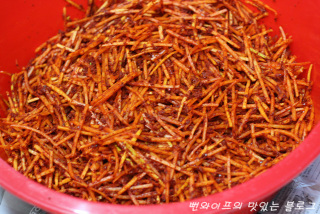
16. Mix thoroughly to coat and color the radish.
Once the radish is nicely stained with gochugaru...
17
18
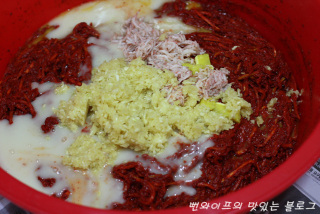
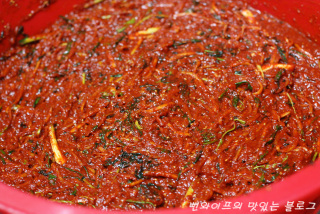
17. Add all the seasoning ingredients and the glutinous rice paste, then mix well.
Let it sit for about 1 hour so the gochugaru can bloom in the moisture.
If using raw shrimp, grind them and mix them in here.
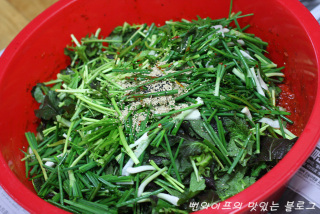
18. Add the prepared scallions, mustard greens, water dropwort, and sea staghorn seaweed, and toss evenly.
19
20
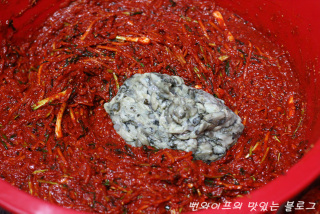
19. Once the vegetables have softened slightly and everything is well mixed, tear off a cabbage leaf, coat it with the seasoning paste, and taste it. If it tastes under-salted, adjust with coarse sea salt.
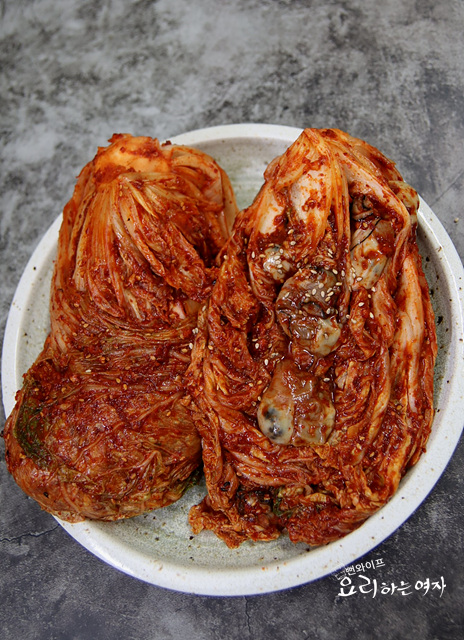
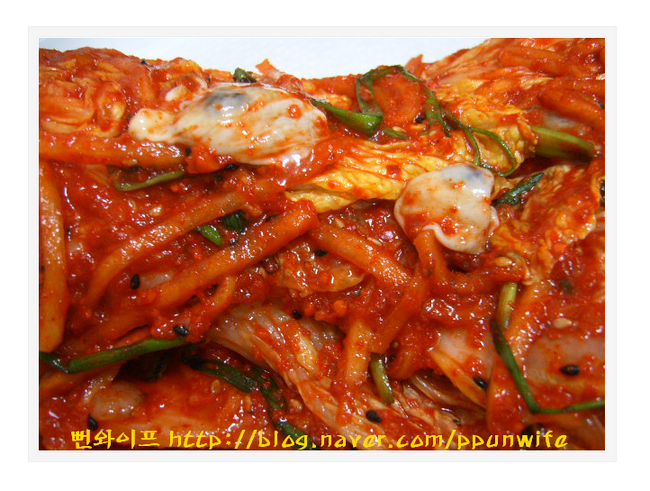
20. If you are adding fresh oysters, fold them in at this stage.
Add oysters only to the kimchi you plan to finish within one month; do not add oysters to kimchi meant to be aged for 2 to 3 months or longer.
21
22
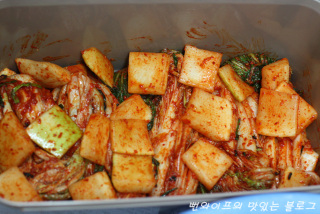
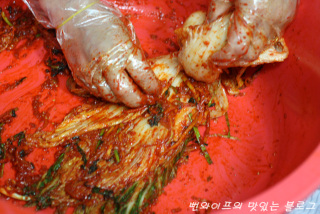
21. Starting from the outermost leaves, fold open the cabbage and spread the kimchi stuffing evenly between each layer.
After applying the paste across the entire leaf, it is best to pack the bulk of the stuffing near the thicker stem portions.
22. If you pack the seasoned cabbage together with lightly salted radish pieces coated in the same paste in alternating layers, you can enjoy them like seokbakji.
 Ppunwife's tips
- Checking the weight of your cabbages before making kimchi ensures accurate seasoning measurements. If the cabbage weight varies, the amounts of seasoning and salting salt must be adjusted accordingly.
- If you slice all the way through with a knife, it will create a lot of scraps.
- Simmering glutinous rice paste with a rich broth lets you create deep flavor in kimchi without adding any artificial seasonings.
- Red mustard greens are typically used for baechu kimchi, while green mustard greens are mainly used for water kimchi.
- Add oysters only to kimchi you plan to finish within one month; avoid adding them to kimchi you intend to keep for 2 to 3 months or longer.
- After brushing the seasoning paste over the leaves, concentrate most of the filling near the thicker stem base.
FAQ
Can I use something else instead of glutinous rice paste?
You can make the kimchi by substituting equal amounts of Korean pear juice and Korean radish juice for the glutinous rice paste.
What should I keep in mind when adding raw oysters to kimchi?
Kimchi made with fresh oysters is best consumed within one month, and it is recommended not to add them to kimchi intended for long-term storage of two to three months or more.
Can I adjust the amount of gochugaru to my liking?
If you prefer a milder, less intensely red seasoning, you can reduce the amount from the default 15 cups down to about 10 cups.
How can I split the cabbage while minimizing loose scraps?
Instead of cutting all the way through with a knife, score only about 10 cm into the base and pull the cabbage apart with your hands to keep crumbly scraps to a minimum.