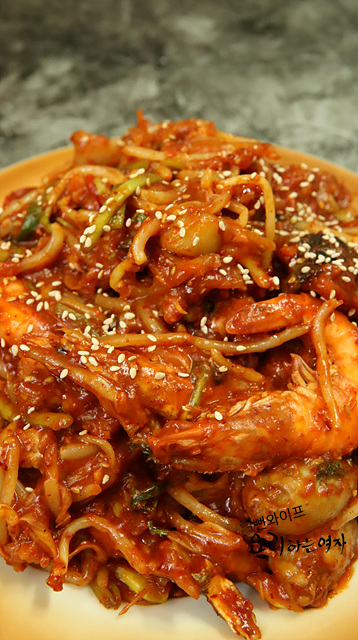
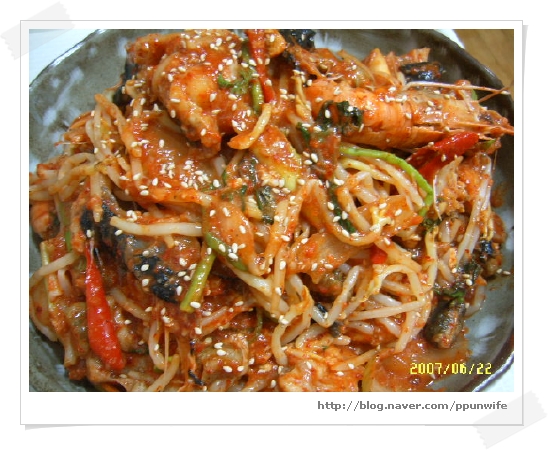
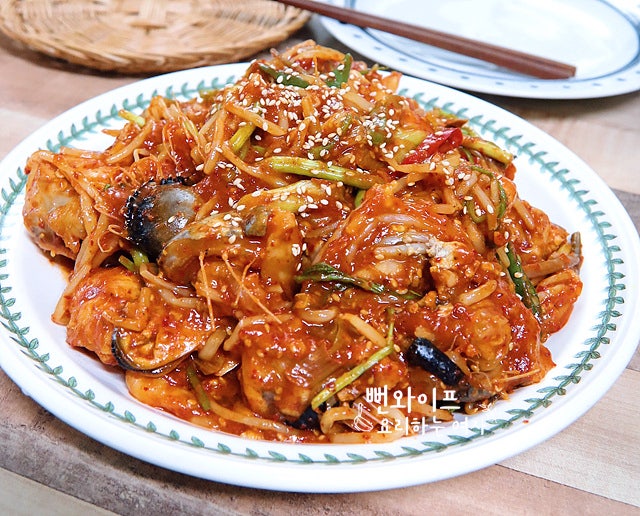
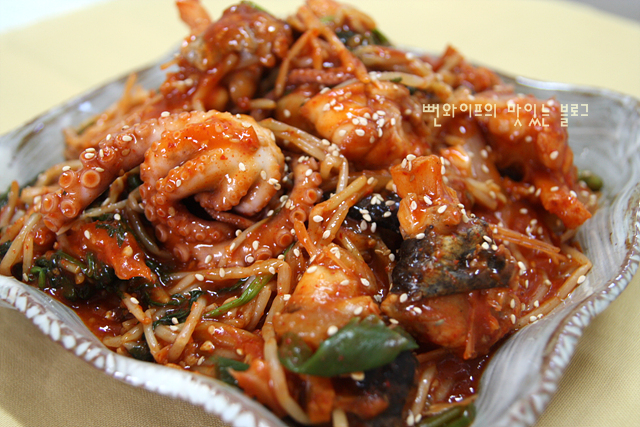
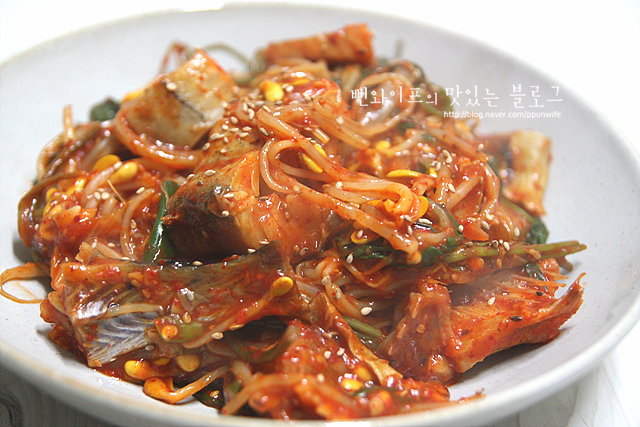
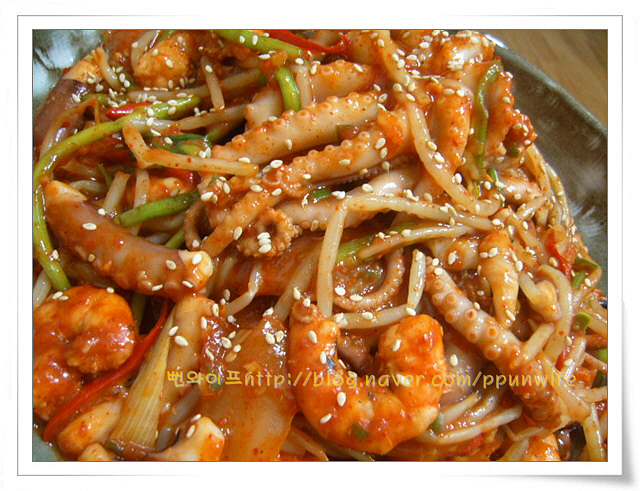
Spicy Agujjim (Braised Spicy Monkfish)
A hearty seafood dish made by stir-braising monkfish and thick soybean sprouts in a spicy, thick seasoning sauce.
Translated from Korean by AI and not yet checked by a native speaker. Amounts and numbers are taken directly from the original recipe. Read the Korean original →
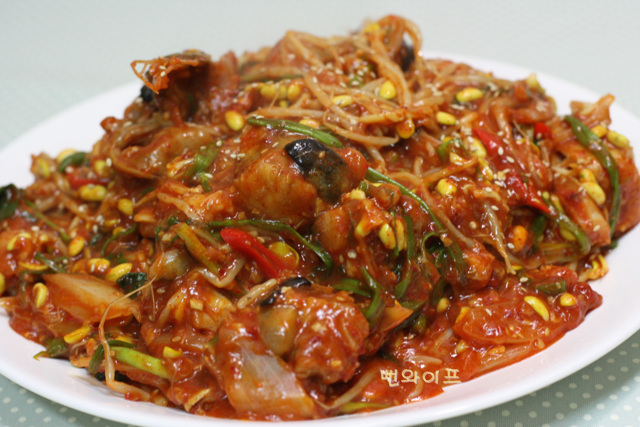
Thick cuts of monkfish are braised spicy with crunchy soybean sprouts and fragrant water dropwort. Using rich anchovy broth and aged seasoning sauce gives this dish a deep umami flavor, perfect for serving guests or enjoying as an accompaniment to drinks.
- Servings
- 4–5 servings
- Difficulty
- Hard
- Spiciness
- Very spicy
Ingredients
Ingredients
- Monkfish1, 1.2 kg (large)
- Mideodeok (sea squirt)1 pack, 150 g
- Thick soybean sprouts for braising500 g
- Water dropwort (minari)100 g
- Onion1
- Large green onion (daepa)1/2 stalks
- Red chili pepper1
- Cheongyang chili pepper (hot green chili)3
- Korean mint (banga)1/2 handful, 10 g
- Rich anchovy broth1 cup
- Potato starch slurry4 tbsp
Monkfish seasoning
- Salt1 tbsp
- Cheongju (Korean rice wine) (or mirin (cooking rice wine))2 tbsp
Soybean sprout seasoning
- Salt1/2 tbsp
Potato starch slurry
- Potato starch (or potato starch)4 tbsp
- Water4 tbsp
Seasoning
- Gochugaru (Korean chili flakes)8 tbsp
- Minced garlic2 tbsp
- Cheongju (Korean rice wine) (or mirin (cooking rice wine))2 tbsp
- Regular soy sauce (jin-ganjang)2 tbsp
- Oyster sauce1 tbsp
- Sugar1 tbsp
- Salt1 tsp
- Ginger juice1/2 tbsp
- Ground black pepper1/2 tsp
- Water or broth3 tbsp
- Toasted sesame oil1 tbsp
- Toasted sesame seedsas needed
- It is best to make the sauce 2 hours ahead so the ingredients blend well and the chili flakes have time to bloom and mature.
- This calls for 1 large monkfish, but you can prepare 2 small ones instead.
- Cut it into bite-sized pieces, gently swish in light salt water to rinse, drain, and sprinkle with 1 tbsp salt and 3 tbsp cheongju (or mirin) to season. Semi-drying it in a cold breeze before cooking will make it even chewier.
- Mideodeok is quite salty, so I rinsed it in clear water and drained it.
- If Korean mint is hard to find, you can substitute perilla leaves.
- I prepared thick soybean sprouts for braising and used them without trimming the heads. Regular soybean sprouts used for salads will wilt too much when braised and lose their crunchy texture.
Steps
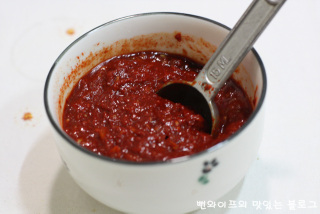
1. Mix all the seasoning ingredients together, except the toasted sesame oil and toasted sesame seeds.
It is best to make the sauce 2 hours ahead so the ingredients blend well and the chili flakes have time to bloom and mature.
For spicy braised dishes, mixing fine and coarse chili flakes half-and-half makes the color much prettier.
I used finely ground spicy Cheongyang chili pepper flakes.
If you do not have Cheongyang chili flakes, blending 5 to 6 red chili peppers into the sauce gives it a much sharper kick.
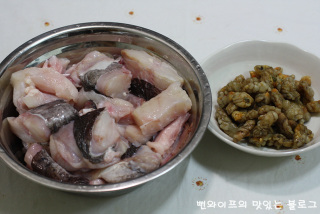
2. This calls for 1 large monkfish, but you can prepare 2 small ones instead.
Cut it into bite-sized pieces, gently swish in light salt water to rinse, drain, and sprinkle with 1 tbsp salt and 3 tbsp cheongju (or mirin)
to season.
If you let it semi-dry in a cold breeze before using, you can enjoy a chewier texture.
I used it straight away without drying.
Mideodeok is salty, so I rinsed it in clear water and drained it.
Among other seafood to prepare alongside monkfish, shrimp or clams are also great.
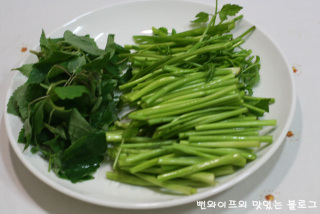
3. Cut the water dropwort into 4 to 5 cm lengths.
I prepared Korean mint leaves; in the Busan and Gyeongnam region, Korean mint
is used to give agujjim its unique aroma. If it is hard to find, you can substitute perilla leaves.
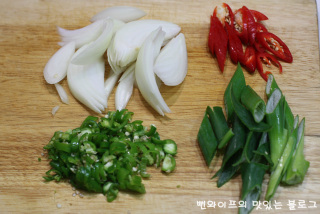
4. Cut the onion into thick slices, slice the large green onion and red chili pepper thickly on a diagonal, and finely chop the spicy Cheongyang chili peppers.
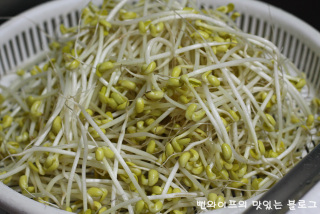
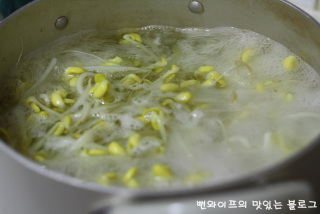
5. I prepared thick soybean sprouts for braising and used them without trimming the heads.
Regular soybean sprouts used for salads will wilt too much when braised and lose their crunchy texture.
6. Add the soybean sprouts to boiling water and blanch for about 3 minutes after the water returns to a boil.
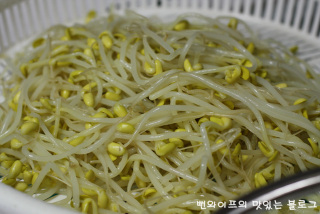
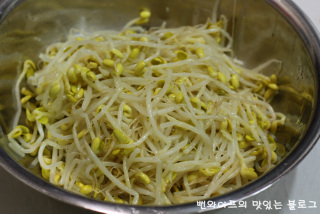
7. Rinse in cold water and drain in a colander...
8. Add salt and toss gently to let the seasoning soak in.
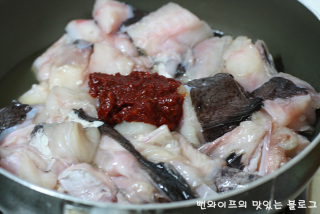
10
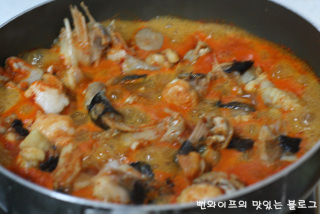
9. Once all ingredients are prepped, start cooking the agujjim in earnest.
In a wide, deep pan, add the monkfish, mideodeok, broth, and half of the prepared sauce...
How to make anchovy broth is here ⇒ http://blog.naver.com/ppunwife/140090439314
Using a richer anchovy broth made with more anchovies and boiled longer than usual
will make the agujjim taste far more savory.
10. Cook over high heat until the monkfish turns white.
11
12
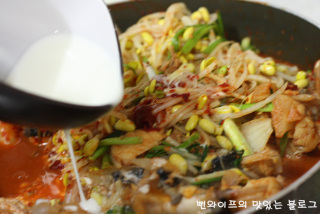
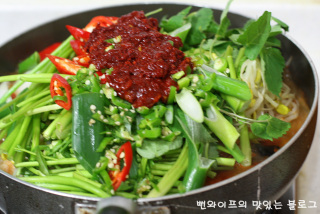
11. Add the blanched soybean sprouts, water dropwort, onion, large green onion, Korean mint, red chili pepper, Cheongyang chili peppers, and the rest of the sauce,
then toss so the sauce and ingredients blend thoroughly.
12. Pour the potato starch slurry in a circle around the pan rather than all in one spot.
13
14
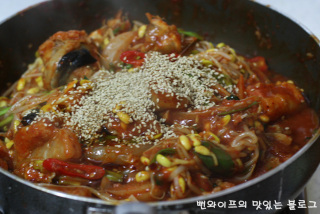
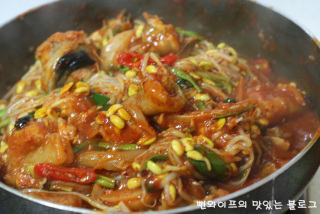
13. Stir evenly and the liquid will thicken while the vibrant color of the sauce comes alive.
If it tastes bland, adjust the seasoning by adding more salt.
14. Finish by adding a generous amount of toasted sesame oil and toasted sesame seeds, tossing to combine.
 Ppunwife's tips
- For spicy braised dishes, mixing fine and coarse chili flakes half-and-half makes the color much prettier.
- If you do not have Cheongyang chili flakes, blending 5 to 6 red chili peppers into the sauce gives it a much sharper kick.
- Using a richer anchovy broth made with more anchovies and boiled longer will make the agujjim far more savory.
- Pour the potato starch slurry in a circle around the pan rather than all in one spot.
FAQ
Can I use regular soybean sprouts meant for salads?
Regular sprouts wilt too much during cooking and lose their crunchy texture, so it is best to use thick-stemmed soybean sprouts intended for braising.
Can I substitute another ingredient for Korean mint?
If Korean mint is unavailable, you can substitute perilla leaves for a similar fresh herbal note.
Is there a tip for a spicier kick and prettier color?
Mix fine and coarse gochugaru half-and-half and let the sauce mature for 2 hours beforehand. If you lack spicy Cheongyang chili flakes, blend 5 to 6 red chili peppers into the sauce for a sharper heat.
Can I add other seafood along with the monkfish?
Yes, you can add various seafood such as shrimp or clams according to your preference.